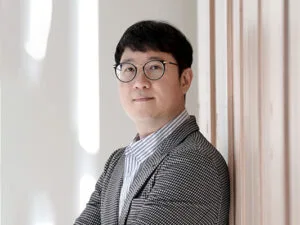
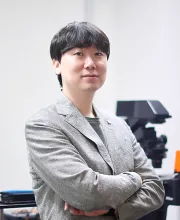
민두영 교수 사진

UNIST화학과

나노 바이오 동역학 연구실

민두영 부교수 (Duyoung Min)

홈페이지의 모집 안내

“Now recruiting graduate students. Scroll down to learn more.”

원문에서 확인하기
연구실 소개

이 연구실은 세포막 환경에서 막단백질이 어떻게 접히며 샤페론이 그 과정을 어떻게 돕는지 단일분자 수준에서 연구합니다. 또한 막 안에서 단백질들이 서로 결합해 파트너십을 형성하는 과정과 이러한 과정의 이상이 질병과 어떻게 연결되는지 살펴봅니다.

AI가 연구실 홈페이지를 바탕으로 생성한 연구실 소개예요

연구실 홈페이지의 소개

Proteins must fold into precise three-dimensional shapes to work, and how they do so is one of the deepest questions in life sciences. For membrane proteins it is even harder: folding happens inside the oily, crowded environment of a cell membrane, a world we still understand poorly and one that AI structure prediction cannot yet explain. These proteins account for the majority of drug targets, so understanding how they fold matters not only for basic science but for medicine. We watch single molecules fold in real time, one at a time, to uncover rules that averaged measurements can never reveal. In a living cell, membrane proteins almost never fold alone. Helper proteins called chaperones guide them, and when this guidance fails, misfolding and disease can follow. Yet how chaperones actually work has been remarkably hard to see, because it means catching a helper and its client in the act. This is where our single-molecule tools open a door that other methods cannot. Understanding how the cell actively shapes folding, rather than leaving it to chance, is a frontier that connects protein folding to quality control, aging, and disease. Proteins rarely act in isolation. Many must find and bind their partners inside the membrane to carry out their jobs, from sensing signals to transporting molecules. How these partnerships form has long been treated as a simple on/off event, but the real process is far richer and mostly hidden from view. We developed a way to take a single protein pair apart and watch it come back together, step by step, inside a membrane. Revealing how molecular partnerships assemble helps explain how cells build the machinery of life, and how that machinery goes wrong in disease. Experiments show us what a molecule does; simulations help us understand wh

원문 보기
연구 분야

물리/계산화학 · 화학생물학/생체재료

컨택 준비
[email protected]

홈페이지에서 읽은 구성원

  • 석박통합과정 4명
  • 구성원 2명
컨택 메일 쓰는 법

정보가 틀렸거나 삭제를 원하시면 [email protected]로 알려 주세요.

비슷한 연구를 하는 연구실