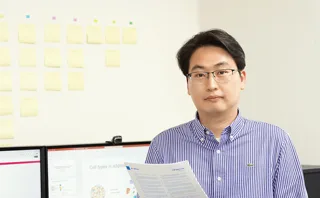
홍인기 교수 사진

KAIST생명과학과신생 랩

Quantitative Intelligence Lab

홍인기 Assistant Professor (Ingie Hong)

연구실 소개

이 연구실은 유전자가 어떤 조직과 세포에서 발현되는지, 또 생존에 얼마나 필수적인지를 고려해 유전자 기능을 연구합니다. GTEx, Allen Brain Atlas, gnomAD 등의 공개 데이터를 활용해 연구 범위를 설정하고 가설을 구체화합니다.

AI가 연구실 홈페이지를 바탕으로 생성한 연구실 소개예요

연구실 홈페이지의 소개

KAIST is in Daejeon, the scientific capital of Korea which houses much of the nation’s R&D. The campus is beautiful and very international, with ample housing inside and nearby. Well-trained scientists and their passion are important rate-limiting assets of our society. Given how many important scientific questions there are to ask, reducing failure and ensuring each of you succeeds is important even beyond your personal career. There are a lot of reasons why a research project can fail, and some of them are avoidable. For biological research that focuses on genes, assessing ‘which cell’ and ‘how essential’ is critical. A brilliant hypothesis about a gene’s function can crumble if the gene isn’t expressed in the right tissue or if it’s so vital that any perturbation is lethal. Fortunately, a wealth of publicly available data can help you de-risk your project from the outset. This post will walk you through a powerful trifecta of online resources—GTEx, Allen Brain Atlas, and gnomAD—to constrain your research scope and build a more robust hypothesis. Before you even think about complex experiments, a fundamental question needs an answer: Is your gene of interest expressed in the tissue you plan to study? The Genotype-Tissue Expression (GTEx) portal is an invaluable resource for exploring gene expression across a wide array of human tissues. The GTEx project has collected data from a multitude of post-mortem donors, providing a comprehensive look at the normal expression landscape. You can visualize both bulk RNA-sequencing data, which gives an average expression level for a tissue, and single-cell RNA-sequencing data for a more granular view. By starting with GTEx, you can quickly confirm if your gene is present in the right biological context, preventing you from pursuin

원문 보기
연구 분야

Brain Science (뇌과학) · Molecular Biology (분자생물학) · Physiology (생리학) · Artificial intelligence(인공지능) · Gene therapy (유전자치료) · Computational Neuroscience (계산신경과학)

컨택 준비
[email protected]

홈페이지에서 읽은 구성원

  • 박사후연구원 1명
  • 박사과정 2명
  • 구성원 1명
컨택 메일 쓰는 법

정보가 틀렸거나 삭제를 원하시면 [email protected]로 알려 주세요.

비슷한 연구를 하는 연구실