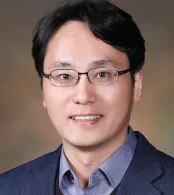
이건열 교수 사진

KAIST전기및전자공학부신생 랩

Photonic Interaction Lab

이건열 조교수 (Gun-Yeal Lee)

홈페이지의 모집 안내

“I am looking for motivated graduate students and postdocs to join the group. If you are excited about optics and photonics, and their system-level applications in AR glasses, computational displays, and optical/quantum computing systems, please feel free to reach out with your CV.”

원문에서 확인하기
연구실 소개

이 연구실은 나노광학으로 빛의 파면, 세기, 편광, 스펙트럼을 제어하는 초박형 메타물질과 메타표면을 개발하고, 이를 광학 시스템에 적용해 웨어러블 디스플레이의 크기와 성능 간 한계를 다룹니다. 물리 원리에 기반한 AI와 계산광학을 활용해 광학 수차와 제작 오차를 예측·보정하고, 홀로그램 입력을 조정해 디스플레이의 화질을 높이는 연구를 합니다.

AI가 연구실 홈페이지를 바탕으로 생성한 연구실 소개예요

연구실 홈페이지의 소개

Our lab aims to create next-generation optical human-computer interfaces by integrating three synergistic domains: Nanophotonics, Optical Systems Engineering, and Physics-informed Machine Learning. We are fundamentally reshaping optical hardware to create new ways to perceive, interact with, and compute with the world using light. Conventional optical elements such as lenses and prisms are constrained by the natural properties of their materials, limiting device functionality and compactness. We break these limits using nanophotonics. By engineering artificial structures at the subwavelength nanoscale, we create ultrathin metamaterials and metasurfaces that allow precise control of the wavefront, intensity, polarization, and spectrum of light. While nanophotonics offers incredible control at the device level, its true potential is realized only when integrated into functional systems. A major focus of our lab is overcoming the fundamental trade-offs between form factor and performance in modern wearable displays. Real-world optical systems inevitably face physical limitations, optical aberrations, and nanofabrication imperfections that prevent them from achieving theoretical perfection. To bridge the gap between simulation and reality, we integrate computational optics and physics-informed AI into the hardware loop. By developing AI models grounded in physical principles and trained on actual experimental data, we can computationally predict, simulate, and invert complex optical processes. For instance, we use these models to computationally "pre-distort" input holograms, canceling out hardware errors and transforming a noisy prototype into a high-fidelity display. This hardware-software co-optimization extends across diverse platforms, including chip-scale quantitative

원문 보기
연구 분야

AI & Machine Learning · Human Computer Interaction · Quantum Science & Engineering · Display Sciences & Engineering · Photonics · Optics · Nanophotonics · Computational Displays · Augmented Reality · Physics-Informed Machine Learning · Neutral-Atom Quantum Computing

컨택 준비
[email protected]

홈페이지에서 읽은 구성원

  • 석박통합과정 1명
  • 석사과정 1명
컨택 메일 쓰는 법

정보가 틀렸거나 삭제를 원하시면 [email protected]로 알려 주세요.

비슷한 연구를 하는 연구실